Who we are
About Vanbreed Consulting Group
Vanbreed. As in a vanishing breed. The kind of technologist who has been building real systems long enough to know that most problems aren't solved by the newest tool. They're solved by someone who asks the right questions first and stays honest about the answers.
We started Vanbreed Consulting Group (VCG) because the market is full of consultants who sell solutions before they understand problems, and full of companies paying for that mistake. We're small by design, which means the person you talk to is the person who does the work. No bait and switch, no junior team inheriting your project after the sales cycle closes. You'll know where things stand, and you'll hear the truth even when it's inconvenient.
VCG is a certified Texas VetHUB vendor, a service-disabled veteran-owned business under the state's Historically Underutilized Business (HUB) program. For public-sector clients such as state agencies, universities, and local governments, work directed to us can count toward veteran-owned and HUB procurement goals, often with a more direct path to contract. For every client, it's independent confirmation of who we say we are.
Alongside our consulting work, we deliver cybersecurity technology services across eight security product families — from privileged access management to governance and risk — for prime contractors and enterprises, from initial design through continuous reporting.
If that sounds like the kind of firm you've been looking for, we'd like to hear about your problem.
Our founder
Allen Cordrey, Founder & Principal Architect
Allen Cordrey has spent 25 years building the kind of systems businesses actually run on. Not demos, not proofs of concept that never shipped. Production systems, in domains where being wrong has consequences: an event-driven pricing platform generating contract prices for more than five million items a day for a national distributor, the first public-facing cloud licensing system for a state government, modernized order-processing pipelines that replaced brittle legacy workflows without breaking the business depending on them. Allen served in the U.S. Army for 10 years and is a service-disabled veteran.
For the last several years that work has centered on a harder question: where does AI actually belong inside a serious system, and where does it not? Allen's answer is a discipline he calls the AI water's edge, drawing a clear line between the deterministic code that validates, calculates, and enforces the rules, and the AI layer that reasons about language, intent, and ambiguity. It's the difference between AI that quietly does real work and AI that becomes an expensive liability. He builds the former: AI added to existing systems through sidecar architectures and MCP, so a stable platform gets smarter without becoming fragile.
That philosophy fits in five words he uses often: make AI useful, boring, and shippable. No hype, no magic, no rewriting a working system for the sake of a demo. Just intelligence added where it earns its place, governed properly, and put into production.
Allen also teaches what he builds. On YouTube he breaks down real AI system-design tradeoffs, and he has published a structured AI fundamentals series in Spanish to widen access to serious AI education beyond the usual audience.
Connect with Allen: LinkedIn · AI With Allen on YouTube
How we work
The Water's Edge
Most consultants arrive with the tool already chosen. It's why so many projects go sideways, the solution gets picked before anyone understands the problem, and then everything bends to fit that choice.
We work from a principle we call the Water's Edge: use the right system for each part of the problem, judged by fit and cost, and accept that most real work needs more than one system working together. AI is a powerful tool. So is a well-designed database, a deterministic rules engine, a simple integration between two things you already own. The skill isn't knowing AI. It's knowing which tool each part of the job actually calls for, and where the line falls between them.
Sometimes that means AI carries the work. Sometimes it means AI has no business touching it, and the honest answer is a boring, reliable system that already does the job. Usually it means several pieces working together, each doing what it's best at, with clear boundaries drawn between them before anyone writes a line of code.
That discipline is the whole difference between technology that pays for itself and technology you're still paying for long after it stopped helping. It's the standard everyone who works here is held to.
Certification
Lead with AI — MasterClass
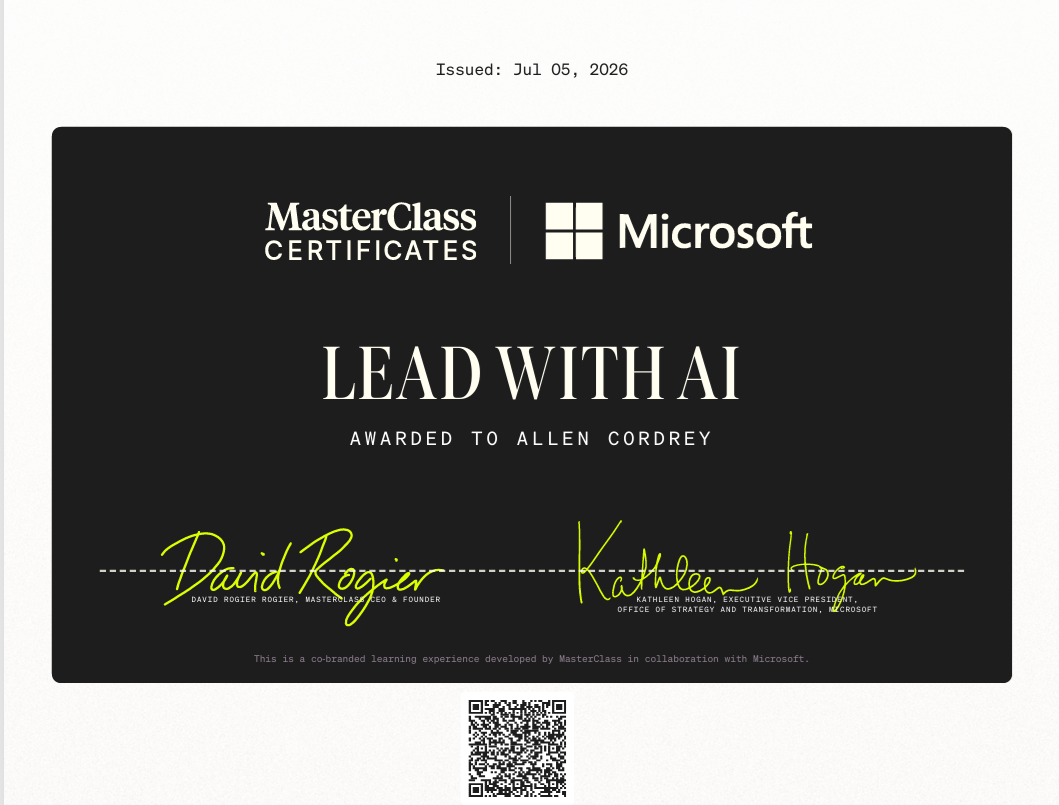
In collaboration with Microsoft (2026). A certificate course taught by senior Microsoft leaders in AI strategy and responsible AI, focused on moving organizations from AI experimentation to measurable business impact.
It's built around a practical arc: identifying the highest-value AI opportunities, standing up pilots that prove ROI quickly, and scaling adoption across teams responsibly, then closing with a working AI transformation roadmap.
That's the same disciplined, results-first approach I bring to helping teams put AI to work without the hype.